Without birds, where would we have learned that there can be song in the heart? [Hal Borland]
 When I step out each morning, the rapid trilling whistles of the Common
Babblers (Turdoides caudatus) seem
to greet me, though I know they are in happy conversation with their own
flock. As I go to the gate to collect
the newspaper, a party of half a dozen babblers suddenly takes flight, barely
making it to the top of the boundary wall in much laboured flight. Finding me a
familiar and harmless figure, they return one by one to their favourite hunting
ground by the hedges. Hopping and slithering around, they forage for insects as
well as berries, while a few elder members perched on the nearby Windmill Palm
maintain a careful lookout, ready to sound a clamorous alarm at the sight of
any predator. The babblers maintain their lively presence all day, and their
whistles can be heard constantly, even though they may be out of sight in the
hedges. To us, these babblers are like watchmen on the lookout for any
intruders, even if these be vagrant cats or a snooping chameleon. [Size 23
cm]
 The cacophony of babblers is broken by the Red Vented Bulbuls (Pycnonotus cafer) that chatter about
melodiously, and quite heartily too. They often leave me enthralled with a
short song or two, of several phrases.
Bulbuls are loveable birds as long as one does not have a fruit orchard,
for these birds can be nasty pests. The
red vented variety is pugnacious in nature and quite possessive of its
territory. It raises loud alarm calls on the sight of predators like cats,
snakes or mongooses. The bulbul’s red
vent under the tail may seem amusing and confusing at the same time, but one can, however, hazard an explanation: any predatory cat would have second thoughts before attacking a Red-vented Bulbul from six o'clock, low! The red flag, thus, may be a beneficial evolutionary trait. Rather surprising is the fact that this
perky bulbul is listed by IUCN amongst the 100 most invasive species, and one
of three amongst all birds. It is said to harm ‘biological diversity’ amongst
ecosystems, being a little bully of sorts. Notwithstanding their
unfavourable attribute, I am unabashedly pleased to see these bulbuls thriving
in our garden, and would love to see them thrash about in their favourite
birdbath for years to come. [Size 20 cm]
 Just as I start to read the newspaper, I am
startled by what sounds like the crackle of electric sparks. With no wires
around as the source of the unusual noise, I find a small warbler-like bird
flap onto the branches of our small Frangipani tree, and break into a resonant cheup, cheup, cheup. I have finally
spotted the little Ashy Prinia (Prinia
socialis), a not too regular visitor in our garden.
With both sexes having a slaty grey upper side blending into the brown
wings, a white throat, and a hint of beige at the belly, they are distinct
enough not to be confused with other species of prinias. The Ashy Prinia hunts
for small insects in the creepers, flicking its graduated tail constantly. Seldom staying for more than a few minutes,
the prinia darts over to the neighbours’ garden, only to be replaced by its
graceful cousin to continue the morning revelry. [Size 13 cm]
 The delicate little Graceful Prinia (Prinia gracilis) has been visiting our garden for years, but it
often takes me a while to be sure, especially when the similar looking Common
Chiffchaff drops by in winters. The
prinia is sandy brown on the upper side with some streaking, and whitish at the
belly, with a long tapering tail. A repetitive zit, zit, zit sounds like a gleeful notification meant for any
prospective mate to join in for company; surely, another prinia alights from
nowhere, and the insect hunt is on in the creepers. The song repertoire of the
little bird includes what sound like trilling breeps and cherleeps to
me. It is hard to tell the cock from the
hen, until I see some aerial antics by what turns out to be a male. Restless as
most prinias are, the pair rapidly shoots off after a few minutes, which is all
it can spare for my amusement. [Size 11 cm]
 An amazing visitor to our garden is the
Common Tailorbird (Orthotomus
sutorius). The little bird is renowned for its remarkable
ability to use its bill for stitching leaves into a nest covering that serves
as a suitable camouflage against predators.
The edges of a big enough leaf are pierced with the bill and ‘sewn’
together with plant fibre to make a sort of a sheath, in which the actual nest
of twigs and dry grass is built. I have not had the opportunity of seeing a
tailorbird’s nest, as there are no suitable trees in our garden whose leaves it
might choose for a home. The bird has
olive green upper sides and creamy lower parts, and can be easily confused with
similar-looking warblers, unless one is careful to note the bird’s rusty-tinged
forehead. The tail is upheld most of the time, and in some males, is said to be
a bit longer than females, though there is no consensus if this is an instance
of sexual dimorphism. Hiding in the
bushes, the tailorbird betrays its presence by the unmistakable territorial
call, chwee-chwee-chwee. [Size 13 cm]

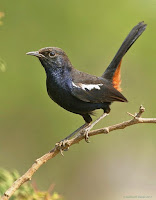 My earliest memories of robins were their images
on the packets of Robin 'Neel' Whitener (indigo powder), a common
household item used for brightening up washed white clothes. These images
were, however, of the Robin Redbreast, a European species different from the Indian
Robin (Saxicoloides fulicata) that
is a common visitor to our garden. Sexually dimorphic, the cock robin is a
majestic little bird with a tail held up emphatically, as it hops about to
forage for insects. Deep brown on the upper side, with white shoulder patches,
it is glossy black on the underside. The hen is beige on the neck, back and
under side, and the wings are brown lacking the white patches. Both sexes have
a chestnut coloured feathery tuft under the tail. The mating dance of the male
is an enchanting display of dazzling plumage, and cannot fail to attract even
the most unresponsive female. The robin is a fine songster, and its repertoire
comprises sharp whistling warbles that are amongst the finest natural melodies
one can hear in a garden. [Size 19 cm]
 The Common
Chiffchaff (Phylloscopus collybita)
is a winter visitor to the Indus plains, and makes its annual presence in our
garden each October, soon after the end of monsoon season. With olive drab upper parts and creamy
underside, it can be confused with the similar looking Graceful Prinia, but for
a much shorter tail. Both sexes are alike in appearance, though the female is
slightly smaller. Since chiffchaffs
breed in spring, their mating habits and nesting behaviour is not observable
during their winter sojourn to Pakistan. The bird gets its name from its
repetitive calls, though it is not as noisy as the rest of the warblers. It usually flits about in the foliage looking
for insects while flicking its wings and tail.
Annual migration to balmy climes is apparently the reason for better
survival prospects, and hence an increasing population of the chiffchaff. [Size
11 cm]

 One of the smaller species of doves that frequent our garden is the Red Collared Dove (Streptopelia
tranquebarica). I have often seen them sipping water from the birdbath
after fluttering down from the terrace railing. Being summer breeding visitors,
they are mostly seen in pairs, cooing ardently as one would expect. Sexually dimorphic, the male has a blue-grey
head, ruddy upper parts, and is paler on the underside; the slightly smaller
female has beige-grey upper parts and is light grey on the underside. Both have
a half-black collar at the neck. The birdcall sounds something like cocoo-coo-cocoo-coo. In our younger
days, we had believed a fanciful fable about this dove. It is said that the
bird had indicated to a passing caravan of Midianites that the teenaged Yousaf
(Joseph, later prophet) had been cast in a well by his jealous
half-brothers. “Yousaf khoo, Yousaf khoo” (“Yousaf
in the well”) is how the dove is supposed to have called out in Punjabi, which
was somehow understood by the Hebrew-speaking travellers, and Yousaf was
miraculously rescued! [Size 23 cm]
 There could not be a more gentle-looking bird in
our garden than the Laughing Dove (Streptopelia senegalensis). It is a
small slim dove with a relatively long tail. Its head and upper parts are
pinkish-beige with the wing edges lined by a streak of grey, and the front of
the neck is mottled with black dots; the lower parts are a lighter shade of
beige. Both sexes are alike. Their flight is quick and direct with the
regular beats, and an occasional flick of the wings. In the breeding season,
males exhibit some aerial antics by rapidly climbing up to about fifty feet,
and then gliding down in a circular pattern for a perfect landing near the
female. I have found this dove to be
somewhat tamer than its collared cousin, and is quite comfortable in the
vicinity of humans. It typically feeds
on the ground, picking up grain and bread scraps. Its mild calls of ohh-HO-ho-ho indeed invoke a hint of merriment and laughter. [Size
27 cm]
 A splendid bird
that is nowadays a rare visitor to our garden, is the Common Hoopoe (Upupa epops).
With its fan-like crest erect while alighting (or when alarmed), it settles
down on the grass and uses its long curved bill to probe for insects and grubs.
The head, neck and under parts of the hoopoe are khaki, while the wings and
square tail are banded black and white. The khaki crest is tipped black and
white. Both sexes are alike in size and appearance. The hoopoe flies in a
smooth wave-like motion due to its broad rounded wings that need not be flapped
rapidly. It has a repetitive, and somewhat mellow, hoop-hoop-hoop call. An allegorical story in the Bible
and the Quran alludes to Hud-Hud, a bird which, in conversation with Prophet
Sulaiman (King Solomon, who knew the language of birds), brings tidings of a
magnificent realm ruled over by the Queen of Saba (Sheba, in Yemen). How Hud-Hud came to be identified as the
hoopoe remains moot, but the story makes for a thought-provoking connection
between theology and ornithology. Unfortunately, this bird of the Scriptures is
decreasing in numbers due to habitat destruction and over-hunting, according to
IUCN estimates. [Size 30 cm]
 Early morning, several Rose-ringed Parakeets (Psittacula krameri) in frantic and
somewhat noisy flight fly across our home. Some of them break their formation and alight on Neem and Jaman trees to eat ripe berries, while others
continue heading south to farm houses rich in fruit trees. Over the years,
their numbers have decreased due to poaching, as they are popular caged birds
in South Asia. Overall these parakeets are bright green turning blue-green at
the tail. They have a curved red bill, powerful enough to help themselves with
most types of nuts and fruits. Males can be identified with a pink collar at
the neck, turning black under the chin. Holes in tree trunks are usually chosen
for nests. Along with their cousin species, the Alexandrine Parakeet, they are serious
pests much detested by farmers. [Size 40 cm]
 The House Crow (Corvus splendens) needs no introduction, as there are childhood
stories galore about its ingenuity and resourcefulness. A scavenger par excellence, the crow is
dependent on man’s presence, and is one of the most familiar birds in any town
or village. Glossy black on the throat
and upper side, with a grey nape, mantle and breast, it may not be impressive
in appearance, but makes up for the lack of colour with its sociable and clever
ways. In our garden, the crow is ever
ready to snatch a morsel, and knows exactly where the food sources like the
kitchen are. I have noted its brainy
abilities as it drops a hard dried piece of naan
in the birdbath to soften it, messing the water in the process. Once soft
enough to be eaten, it flies away with the piece of bread into the tall trees
for a hearty meal. Occasionally, it gets into a dogfight with its competitor,
the Pariah Kite, and manages to score direct hits with its beak, being the more
adroit of the two. The crow seems to have a live-and-let-live relationship with
other birds that visit the garden, despite being much bigger than they
are. It will remain a welcome visitor
for its presence in our garden reminds us that birds of different feathers can
still flock together. [Size 40 cm]

 The House
Sparrow (Passer domesticus) is
well known around human dwellings, and is the most common bird in our garden.
It is omnivorous, so it subsists on any morsels left over from our dining
table, alongside insects and seeds rummaged from the garden. The bird is
considered a pest and causes significant damage to ripening wheat, though that
is not our concern, mercifully. Sexually dimorphic, the male is markedly
distinct from the female. The cock sparrow has a grey crown, black throat, and
brown upper parts with black and grey striations. The hen has beige upper
parts, also with black and grey striations. The under parts of both sexes are
greyish-white. The sparrows can be seen chirping around the birdbath, quenching
their thirst, and also taking refreshing baths in the hot summer season. A wary
bird, the sparrow keeps its distance from man, but mixes well with most other
birds, especially fellow scroungers like crows and mynas. While sparrows
continue to thrive in our part of the world, their declining numbers due to use
of pesticides in Europe should raise concerns in Pakistan too. It would be a
pity if children had to interrupt the delightful story of the crow and sparrow
doing a khichri (kedgeree) cooking
project, by asking what a sparrow looked like. [Size 15 cm]
 The most raucous and lively bird of our garden
is the Common Myna (Acridotheres tristris). Widely known in
towns and villages like the sparrows and crows, the myna is adaptable and
opportunist, qualities that have helped it thrive in all environments. IUCN
reports an increase in the population of this myna, worldwide. Both sexes have
similar appearance and size. The neck and forehead are black, shading into a
deep grey at the breast; the rest of the bird is brown, except for a white wing
patch and a white tail tip. A yellow patch around the eye and yellow bill are
features common to all mynas. The bird has a rich vocabulary, and always seems
to be in some kind of conversation with members of its group. The mynas are first to raise alarm on sighting
predators like cats and big lizards, and continue with incessant dive attacks
to scare them away. [Size 25 cm]
________________________
Picture Credits:
Location - Lahore, Pakistan
Garden Size - 9.8m x 4.8m (32' x 16')

 A sibilant tweet heralds the arrival of the Purple Sunbird (Nectarinia asiatica), and I instantly know where to look for the tiny bird, one of the smallest in Pakistan. Our Rangoon Creeper, with its boughs laden with fragrant pink flowers, is where these birds have breakfast of sweet nectar every morning. The male, in dazzling iridescent purple tinged with cobalt blue and black, is an enchanting sight, darting about from flower to flower. Though the drab olive female has no role in attracting mates – unlike mammalia – it does have a keen eye for anything that is lustrous, purple, and flies. Done with their high energy morning meal, the pair darts off, but I continue to hear the sharp call notes of the sunbirds until midday, flitting about in the tall Neem and Jaman trees in the neighbourhood. The sights and sounds of the sunbirds does wonders to my mood at the start of the day, so I make sure that the flowery creeper along our garden wall is in good shape, and loaded with sweet delights for the charming visitors. [Size 10 cm]
 The Brown
Rock Chat (Oenanthe fusca) is
usually the first bird to serenade me with its sweet song at daybreak. When I
first heard the tuneful aria, I hurried out to see the bird, which turned out
to be quite like a female robin, but for its brown head and breast, with wings
and tail shading off into a dark chocolate colour. Perched on the gate, it jerked its
head as if startled, but I found this to be a recurring action every 10-15
seconds. Careful observation revealed that a gradual lifting of its tail
precedes the jerky head movement, but there seems no explanation for this odd
motor action. The chats are quite wary of human presence, and as I try to
approach one for a closer look, it immediately flies off to the ledge. I have seldom seen a chat perch on a tree, as
buildings and similar structures are its preferred hangouts. With both sexes
being alike, and their rich repertoire of calls and songs quite similar, the
musical performance seems more of a synchronised duet. [Size 17 cm]

 The cacophony of babblers is broken by the Red Vented Bulbuls (Pycnonotus cafer) that chatter about
melodiously, and quite heartily too. They often leave me enthralled with a
short song or two, of several phrases.
Bulbuls are loveable birds as long as one does not have a fruit orchard,
for these birds can be nasty pests. The
red vented variety is pugnacious in nature and quite possessive of its
territory. It raises loud alarm calls on the sight of predators like cats,
snakes or mongooses. The bulbul’s red
vent under the tail may seem amusing and confusing at the same time, but one can, however, hazard an explanation: any predatory cat would have second thoughts before attacking a Red-vented Bulbul from six o'clock, low! The red flag, thus, may be a beneficial evolutionary trait. Rather surprising is the fact that this
perky bulbul is listed by IUCN amongst the 100 most invasive species, and one
of three amongst all birds. It is said to harm ‘biological diversity’ amongst
ecosystems, being a little bully of sorts. Notwithstanding their
unfavourable attribute, I am unabashedly pleased to see these bulbuls thriving
in our garden, and would love to see them thrash about in their favourite
birdbath for years to come. [Size 20 cm]
 Just as I start to read the newspaper, I am
startled by what sounds like the crackle of electric sparks. With no wires
around as the source of the unusual noise, I find a small warbler-like bird
flap onto the branches of our small Frangipani tree, and break into a resonant cheup, cheup, cheup. I have finally
spotted the little Ashy Prinia (Prinia
socialis), a not too regular visitor in our garden.
With both sexes having a slaty grey upper side blending into the brown
wings, a white throat, and a hint of beige at the belly, they are distinct
enough not to be confused with other species of prinias. The Ashy Prinia hunts
for small insects in the creepers, flicking its graduated tail constantly. Seldom staying for more than a few minutes,
the prinia darts over to the neighbours’ garden, only to be replaced by its
graceful cousin to continue the morning revelry. [Size 13 cm]

 An amazing visitor to our garden is the
Common Tailorbird (Orthotomus
sutorius). The little bird is renowned for its remarkable
ability to use its bill for stitching leaves into a nest covering that serves
as a suitable camouflage against predators.
The edges of a big enough leaf are pierced with the bill and ‘sewn’
together with plant fibre to make a sort of a sheath, in which the actual nest
of twigs and dry grass is built. I have not had the opportunity of seeing a
tailorbird’s nest, as there are no suitable trees in our garden whose leaves it
might choose for a home. The bird has
olive green upper sides and creamy lower parts, and can be easily confused with
similar-looking warblers, unless one is careful to note the bird’s rusty-tinged
forehead. The tail is upheld most of the time, and in some males, is said to be
a bit longer than females, though there is no consensus if this is an instance
of sexual dimorphism. Hiding in the
bushes, the tailorbird betrays its presence by the unmistakable territorial
call, chwee-chwee-chwee. [Size 13 cm]

 My earliest memories of robins were their images
on the packets of Robin 'Neel' Whitener (indigo powder), a common
household item used for brightening up washed white clothes. These images
were, however, of the Robin Redbreast, a European species different from the Indian
Robin (Saxicoloides fulicata) that
is a common visitor to our garden. Sexually dimorphic, the cock robin is a
majestic little bird with a tail held up emphatically, as it hops about to
forage for insects. Deep brown on the upper side, with white shoulder patches,
it is glossy black on the underside. The hen is beige on the neck, back and
under side, and the wings are brown lacking the white patches. Both sexes have
a chestnut coloured feathery tuft under the tail. The mating dance of the male
is an enchanting display of dazzling plumage, and cannot fail to attract even
the most unresponsive female. The robin is a fine songster, and its repertoire
comprises sharp whistling warbles that are amongst the finest natural melodies
one can hear in a garden. [Size 19 cm]
 The Common
Chiffchaff (Phylloscopus collybita)
is a winter visitor to the Indus plains, and makes its annual presence in our
garden each October, soon after the end of monsoon season. With olive drab upper parts and creamy
underside, it can be confused with the similar looking Graceful Prinia, but for
a much shorter tail. Both sexes are alike in appearance, though the female is
slightly smaller. Since chiffchaffs
breed in spring, their mating habits and nesting behaviour is not observable
during their winter sojourn to Pakistan. The bird gets its name from its
repetitive calls, though it is not as noisy as the rest of the warblers. It usually flits about in the foliage looking
for insects while flicking its wings and tail.
Annual migration to balmy climes is apparently the reason for better
survival prospects, and hence an increasing population of the chiffchaff. [Size
11 cm]

 One of the smaller species of doves that frequent our garden is the Red Collared Dove (Streptopelia
tranquebarica). I have often seen them sipping water from the birdbath
after fluttering down from the terrace railing. Being summer breeding visitors,
they are mostly seen in pairs, cooing ardently as one would expect. Sexually dimorphic, the male has a blue-grey
head, ruddy upper parts, and is paler on the underside; the slightly smaller
female has beige-grey upper parts and is light grey on the underside. Both have
a half-black collar at the neck. The birdcall sounds something like cocoo-coo-cocoo-coo. In our younger
days, we had believed a fanciful fable about this dove. It is said that the
bird had indicated to a passing caravan of Midianites that the teenaged Yousaf
(Joseph, later prophet) had been cast in a well by his jealous
half-brothers. “Yousaf khoo, Yousaf khoo” (“Yousaf
in the well”) is how the dove is supposed to have called out in Punjabi, which
was somehow understood by the Hebrew-speaking travellers, and Yousaf was
miraculously rescued! [Size 23 cm]
 There could not be a more gentle-looking bird in
our garden than the Laughing Dove (Streptopelia senegalensis). It is a
small slim dove with a relatively long tail. Its head and upper parts are
pinkish-beige with the wing edges lined by a streak of grey, and the front of
the neck is mottled with black dots; the lower parts are a lighter shade of
beige. Both sexes are alike. Their flight is quick and direct with the
regular beats, and an occasional flick of the wings. In the breeding season,
males exhibit some aerial antics by rapidly climbing up to about fifty feet,
and then gliding down in a circular pattern for a perfect landing near the
female. I have found this dove to be
somewhat tamer than its collared cousin, and is quite comfortable in the
vicinity of humans. It typically feeds
on the ground, picking up grain and bread scraps. Its mild calls of ohh-HO-ho-ho indeed invoke a hint of merriment and laughter. [Size
27 cm]
 A splendid bird
that is nowadays a rare visitor to our garden, is the Common Hoopoe (Upupa epops).
With its fan-like crest erect while alighting (or when alarmed), it settles
down on the grass and uses its long curved bill to probe for insects and grubs.
The head, neck and under parts of the hoopoe are khaki, while the wings and
square tail are banded black and white. The khaki crest is tipped black and
white. Both sexes are alike in size and appearance. The hoopoe flies in a
smooth wave-like motion due to its broad rounded wings that need not be flapped
rapidly. It has a repetitive, and somewhat mellow, hoop-hoop-hoop call. An allegorical story in the Bible
and the Quran alludes to Hud-Hud, a bird which, in conversation with Prophet
Sulaiman (King Solomon, who knew the language of birds), brings tidings of a
magnificent realm ruled over by the Queen of Saba (Sheba, in Yemen). How Hud-Hud came to be identified as the
hoopoe remains moot, but the story makes for a thought-provoking connection
between theology and ornithology. Unfortunately, this bird of the Scriptures is
decreasing in numbers due to habitat destruction and over-hunting, according to
IUCN estimates. [Size 30 cm]

 The House Crow (Corvus splendens) needs no introduction, as there are childhood
stories galore about its ingenuity and resourcefulness. A scavenger par excellence, the crow is
dependent on man’s presence, and is one of the most familiar birds in any town
or village. Glossy black on the throat
and upper side, with a grey nape, mantle and breast, it may not be impressive
in appearance, but makes up for the lack of colour with its sociable and clever
ways. In our garden, the crow is ever
ready to snatch a morsel, and knows exactly where the food sources like the
kitchen are. I have noted its brainy
abilities as it drops a hard dried piece of naan
in the birdbath to soften it, messing the water in the process. Once soft
enough to be eaten, it flies away with the piece of bread into the tall trees
for a hearty meal. Occasionally, it gets into a dogfight with its competitor,
the Pariah Kite, and manages to score direct hits with its beak, being the more
adroit of the two. The crow seems to have a live-and-let-live relationship with
other birds that visit the garden, despite being much bigger than they
are. It will remain a welcome visitor
for its presence in our garden reminds us that birds of different feathers can
still flock together. [Size 40 cm]

 The House
Sparrow (Passer domesticus) is
well known around human dwellings, and is the most common bird in our garden.
It is omnivorous, so it subsists on any morsels left over from our dining
table, alongside insects and seeds rummaged from the garden. The bird is
considered a pest and causes significant damage to ripening wheat, though that
is not our concern, mercifully. Sexually dimorphic, the male is markedly
distinct from the female. The cock sparrow has a grey crown, black throat, and
brown upper parts with black and grey striations. The hen has beige upper
parts, also with black and grey striations. The under parts of both sexes are
greyish-white. The sparrows can be seen chirping around the birdbath, quenching
their thirst, and also taking refreshing baths in the hot summer season. A wary
bird, the sparrow keeps its distance from man, but mixes well with most other
birds, especially fellow scroungers like crows and mynas. While sparrows
continue to thrive in our part of the world, their declining numbers due to use
of pesticides in Europe should raise concerns in Pakistan too. It would be a
pity if children had to interrupt the delightful story of the crow and sparrow
doing a khichri (kedgeree) cooking
project, by asking what a sparrow looked like. [Size 15 cm]
 The most raucous and lively bird of our garden
is the Common Myna (Acridotheres tristris). Widely known in
towns and villages like the sparrows and crows, the myna is adaptable and
opportunist, qualities that have helped it thrive in all environments. IUCN
reports an increase in the population of this myna, worldwide. Both sexes have
similar appearance and size. The neck and forehead are black, shading into a
deep grey at the breast; the rest of the bird is brown, except for a white wing
patch and a white tail tip. A yellow patch around the eye and yellow bill are
features common to all mynas. The bird has a rich vocabulary, and always seems
to be in some kind of conversation with members of its group. The mynas are first to raise alarm on sighting
predators like cats and big lizards, and continue with incessant dive attacks
to scare them away. [Size 25 cm]
________________________
Picture Credits:
Purple Sunbird (M) – Achintiya Das
Purple Sunbird (F) – Arun Bhatt
Rock Chat – Kesavan D
Common Babbler – Raju Kasambe
Red-vented Bulbul –
Arthur de Wolf
Ashy Prinia – Abhinav R
Graceful Prinia – Dikkuyruklu O Hegen
Common Tailorbird – Simon Richards
Indian Robin (M) – Siddharth Damle
Indian Robin (F) – Rick Toor
Common Chiffchaff – Carlos Capitan Romero
Red Collared Dove (M) – Stanislav
Harvancik
Red Collared Dove (F) – Israel G Momin
Laughing Dove – Rohit Kumar Balodia
Common Hoopoe – Jiri Bohdal
Rose-ringed Parakeet (M) - Kalyan Gantait
Rose-ringed Parakeet (M) - Kalyan Gantait
House Crow – Mahdi Karim
House Sparrow (M & F) – Armando Caldas
Common Myna – Viral G
Pankaj
© KAISER TUFAIL. This is an open-access article published under the terms and conditions of the Creative Commons Attribution Licence, which permits unrestricted use, distribution, and reproduction in any medium, provided the original author and source are credited.


